

Small dogs are easy to pick up. They're easy to carry into the vets, lift onto the examination table and hold still while somebody looks in an ear or examines a sore leg.
And that's exactly why we need to think carefully about how we handle them.
When a much larger dog doesn't want to go somewhere or doesn't want part of their body examined, their size means we often have to pay attention. We can't simply scoop them up and carry on. With a small dog, we physically can.
But being able to hold a dog still doesn't necessarily mean they're comfortable with what's happening.
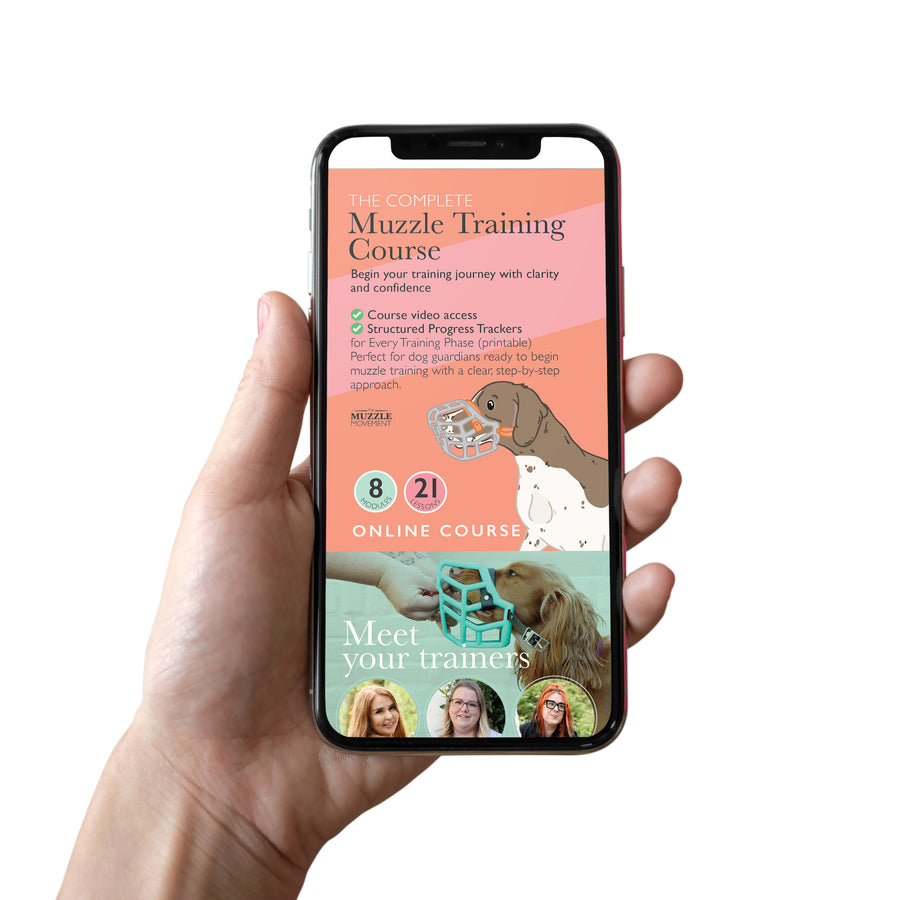
As part of our Small Dogs, Big Feelings campaign, we want to encourage more guardians to think about muzzle training their small dogs, not because small dogs are more likely to bite, and not so that we can ignore what they're communicating and carry on regardless, but because they deserve the same preparation and consideration that we'd give a much larger dog.
What does a veterinary practice look like when you're tiny?
It's worth thinking about vet visits from a small dog's physical perspective.
An examination table that's a manageable height to us can be many times the height of a small dog. Once they're placed on it, getting down isn't necessarily an option. A veterinary professional leaning over to examine their face is much larger than they are, and even a human hand can cover a significant proportion of a very small dog's body.

Then there's the equipment. A stethoscope seems pretty small to us, and against a larger dog's body. Against the chest of a tiny dog, it's proportionally much bigger. An otoscope approaching an ear, an ophthalmoscope coming towards an eye, clippers, thermometers, needles and all the other unfamiliar equipment involved in veterinary care can look, sound and feel very different when you're only a few kilograms yourself.
That doesn't mean every small dog finds veterinary examinations frightening. Plenty of small dogs are very comfortable at vet visits. It simply means that scale matters, and it's worth considering when we're asking why a dog might be worried about something that seems completely ordinary to us.
Small dogs can be moved through situations they wouldn't choose themselves
Imagine a large dog who is worried about going into the vets. They stop outside the door. They hesitate when they're asked to enter the consulting room. They move away when somebody approaches them. They don't want to get onto the scales.

Their reluctance can be difficult to miss.
Now think about how easily we can move a small dog through those same situations.
We can carry them through the front door, lift them onto the scales, pick them up again, carry them into the consulting room and place them onto the examination table.

None of those things is inherently wrong, and there are plenty of situations where carrying a small dog is sensible or necessary. The difference is that their size makes it much easier for us to override their reluctance without necessarily meaning to.
The same thing can happen during an examination. If a small dog turns their head away, pulls a paw back or tries to move away, it's physically quite easy to hold them in place. If they struggle, we can hold them a little tighter.

If they growl or snap, there's also a risk of their behaviour being dismissed because they're small. They're "being dramatic." They're "feisty." They're "a typical little dog."
But what if we stopped thinking about how easy the behaviour is for us to manage and started asking what the dog is trying to tell us?
Their feelings don't become smaller because their teeth are
A bite from a small dog may pose a different level of injury risk from a bite from a much larger dog, but that doesn't tell us anything about how frightened, uncomfortable or overwhelmed the dog feels.
If a small dog is freezing, struggling, growling, snapping or trying to bite during veterinary handling, that's information, and their size shouldn't determine how seriously we take it.

Of course, veterinary professionals sometimes need to carry out procedures that dogs would rather they didn't. There will be situations where restraint is necessary, just as there will be dogs who benefit from pain relief, pre-visit medication, sedation or other changes to how their veterinary care is managed.
Muzzle training can be another useful part of that preparation, not because putting a muzzle on means we can stop listening to the dog. A muzzle should never be permission to push a dog further simply because the risk of a bite has been reduced.
Instead, positively training a small dog to comfortably wear a well-fitting muzzle means that if one is needed, we're not adding another unfamiliar or frightening experience to an already difficult situation.

Small dogs hurt too
There are also health reasons why preventative muzzle training deserves more consideration for small dogs. Some conditions are so commonly associated with particular types of small dog that we can almost start to think of them as normal.
That little skip or "Jack Russell hop," for example, might be brushed off as a quirky way of walking, when skipping can be associated with patellar luxation. The "cute" Pug snorts can be a soft palate issue, and many small dogs have beautiful, big eyes which is often part of why they are so attractive, but these can be easily injured.

Dental disease is another important consideration. Small dogs are particularly susceptible to periodontal disease, and examining a painful mouth requires somebody to work very closely around the dog's face.
Ear infections, spinal and neurological conditions and other orthopaedic problems can all involve close handling and potentially uncomfortable examinations too, and can be commonplace for small breed dogs. The point isn't that every small dog will develop one of these conditions, it's that being small certainly doesn't protect a dog from pain, and pain can change how an individual feels about being touched.
A dog who has happily tolerated having their legs moved, mouth examined or ears handled for years may feel very differently when that part of their body suddenly hurts.
If they're already comfortable wearing their own muzzle, that's one less new thing to introduce if their veterinary team decides one would be useful at future vet visits.

What if my small dog already uses aggressive behaviour at the vets?
Small dogs who growl, snap or try to bite during veterinary handling aren't necessarily already comfortable wearing a muzzle. Sometimes the opposite is true.

Due to the fact that they're physically easier to restrain, a muzzle might only appear when it's absolutely necessary and be put on quickly so that treatment can continue. The dog is already worried, they're being handled, and now an unfamiliar piece of equipment is being placed onto their face too.
If that happens repeatedly, it's understandable that the muzzle itself can become part of the negative experience. Positive muzzle training gives us an opportunity to change that.
Your dog's own muzzle can be introduced slowly at home. They can learn to put their nose into it voluntarily, take treats through it and gradually become comfortable wearing it. They can wear it on ordinary walks and during completely uneventful parts of life so that it doesn't only appear when something unpleasant is about to happen.

Being small can make scavenging more significant too
For dogs who pick up things they shouldn't on walks, a suitable muzzle can also be used to help prevent scavenging.
Bodyweight can be particularly relevant when we're talking about toxic substances, because many toxic doses are calculated relative to the dog's weight. If a 4kg dog and a 40kg dog consume the same amount of a dose-dependent toxin, the smaller dog has potentially consumed a much greater amount relative to their bodyweight.
Dropped medication is a good example of why size can matter. One tablet is still one tablet whether the dog who finds it weighs 4kg or 40kg.
The size of an object relative to the dog can matter too when we're thinking about choking or gastrointestinal foreign bodies. Something that looks relatively insignificant to us can be substantial compared with a very small dog's airway or digestive tract.
For a small dog who is a determined scavenger, an appropriately fitted muzzle can therefore have an important safety role.
Choosing the right dog muzzle for a small breed
There's another misconception we'd really like to change: that some dogs are simply too small to need a "proper" muzzle.

A small dog's muzzle should meet the same basic welfare requirements we'd expect for a larger dog. It should fit their individual face and should be secure and comfortable. A basket muzzle intended for normal wear should provide appropriate space for them to open their mouth and pant.
And, importantly, they should be introduced to it properly. We don't want a dog simply tolerating something strapped around their face because they're small enough that we can put it there. We want them to understand the equipment and be genuinely comfortable wearing it.
For very small dogs, the weight and scale of the equipment itself are also worth considering. This is one of the reasons we've put so much work into expanding the range of dogs who can comfortably wear The Muzzle Movement dog muzzle. Small dogs deserve thoughtfully designed equipment too, and we are working on going smaller.

Small Dogs, Big Feelings
We talk a lot about preparing dogs for veterinary care, and we've written separately about why we believe preventative muzzle training is a useful life skill for dogs generally.
Small dogs deserve a conversation of their own. Their size changes how they experience the world, but it also changes how we respond to them. It's easier to pick them up. Easier to move them. Easier to hold them still. Easier to laugh off a growl or a snap because we're confident we can physically manage what happens next.
A small dog doesn't need to pose a significant danger to us before their fear matters. They don't need to have bitten somebody before they're worth muzzle training. And we don't need to wait until they're frightened, painful or urgently need a muzzle before we introduce one.
Their feelings don't become smaller because their teeth are.
Small dogs deserve choice where we can give it, thoughtful handling when we can't, equipment that actually fits them, and preparation for the situations life may throw at them.
They might be little, but their feelings aren't.